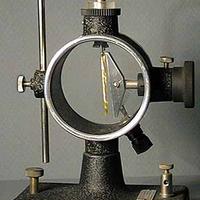
As described in the Cenco catalog. The instrument is finished in black crinkle enamel with polished metal fittings. The cast iron base is 4.5 x 2.75". The instrument is 6.25" high to the top of the fixed plate. The windows are 2.5" in diameter held on with polished aluminum bezels.
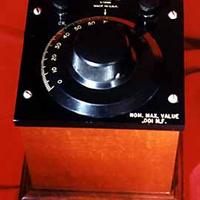
The instrument is about 5.5 x 5.5 x 7 inchs high. It has a dial with 0100 divisions and two binding posts on a polished black bakelite top, mounted on a mahogany box. It is stamped NOM. MAX. VALUE .001 MF in the lower right corner on the top.
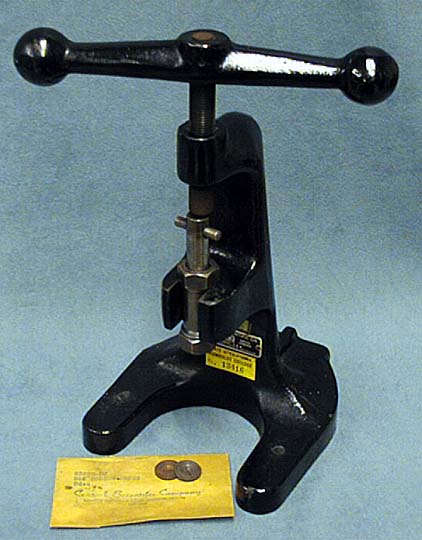
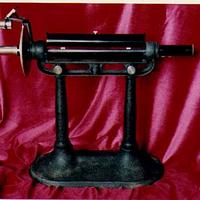
The instrument stands 9" to the top of the base, which is 5 7/8" wide at its widest point. The finely threaeded 9/16" dia. screw is 3" long, with an 8" handle. The base is of heavy, japanned cast iron. There is a compartment in the back for storing a machined and polished 1/2" dia. x 2 1/16" long steel plunger. The cell is machned from 7/8" steel hex stock, with a 1/2" hole bored down the center. A threaded cap holds the thin steel die. The museum has four dies, three pinhole: 0.25, 0.5, 1.0, and one 0.4 x 6 ribbon, which is cracked from use. The 0.25 die is obviously copper plated, the others are heavily patinated. Two of the original die envelopes are also in the collection, of different apparent vintages. One appears to be associted with this instrument, while the second, more recent envelope (along with most of the dies) was with a second, newer, and unused die press. The plunger is 2 1/2" long with a cross-peace 1/4" from the end.
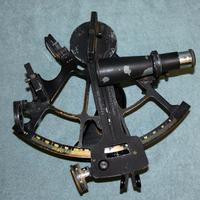
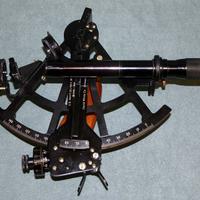
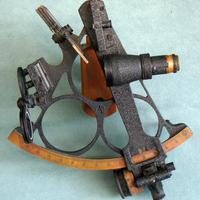
The modern navigational sextant is designed to precisely and accurately measure the angle between two points. In modern usage it is most commonly used to measure the altitude of a celestial object or the angle between a celestial object and the horizon. The sextant is so named because its arc encompasses one sixth of a circle (60°), however, due to the optical properties of the reflecting system it measures up to a third of a circle (120°).
The modern navigational sextant is designed to precisely and accurately measure the angle between two points. In modern usage it is most commonly used to measure the altitude of a celestial object or the angle between a celestial object and the horizon. The sextant is so named because its arc encompasses one sixth of a circle (60°), however, due to the optical properties of the reflecting system it measures up to a third of a circle (120°).
This sextant was used to instruct oceanography students at Humboldt. When the sextant was transferred to the Museum in September 2010 there were a total of nine sextants in the Natural Resources stockroom.
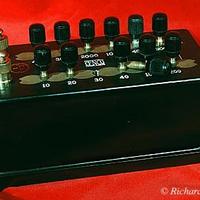
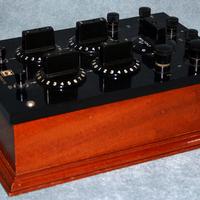
The instrument is contained in a one piece cast bakelite case, the top of which has been ground flat. The binding posts are of polished brass with captured knurled nuts. The resistance value is adjusted by inserting plugs (tapered brass with black bakelite handles) into holes connecting brass lugs which are embedded into the top surface of the case. The total resistance of the box is 11,100 ohms divided as follows: 10, 20, 30, 40, 100, 200, 300, 400, 1000, 2000, 3000, & 4000. The name Cenco is engraved into the top center of the case. The name and resistance values are all white filled. There is a red ink stamp near the binding posts, consisting of a circle within a circle and the figures c.s. / 1 inside the center circle. The bottom of the case is covered by a perforated aluminum sheet, held on by four brass screws at the corners, u.s. pat. 1,781,802 is ink stamped in black 1/2" figures across it.
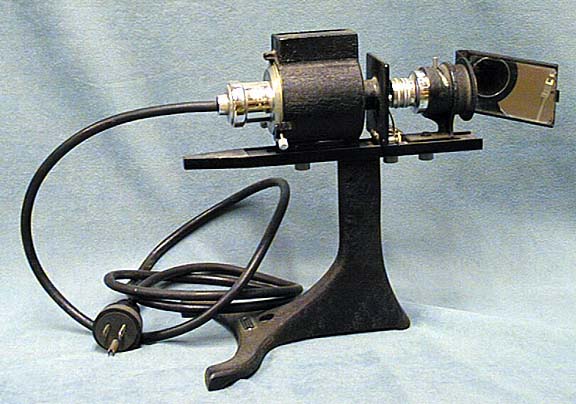
The instrument stands 9 3/4" high with the optical bench horizontal, and 11 1/2" to 12 5/8" high to the tip of the mirror with the bench vertical and the mirror mount flush with the lens holder (varied by moving the lens mount along the bench). The cast-iron stnad, lamp housing, stage and lens mount are all painted in black crinkle enamal, the short optical bench is black japanned. All unpainted metal surfaces appear to be chrome plated. The front element of the divisible objective lens is on a spring loaded pivot so it can be easily swung in or out of the optical path. The instrument stands A black enameled metal tag on the back of the stand reads, in raised metal letters:
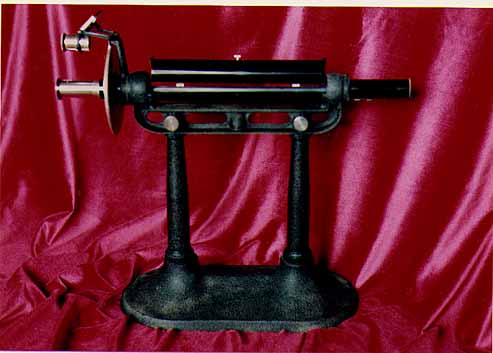
The instrument is supported by two tapered iron pillars, to give an overall height of 16" on an oval cast iron base (6 1/2 x 13 1/2"), all in black crinkled finish. The 4.75" readout circle is graduated in degrees, with a vernier readout to 0.1° observed through a magnifier, and illuminated via a small adjustable mirror. Original decal (now removed): State of California/43919.
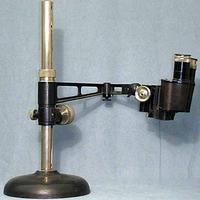
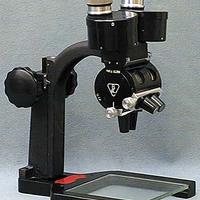
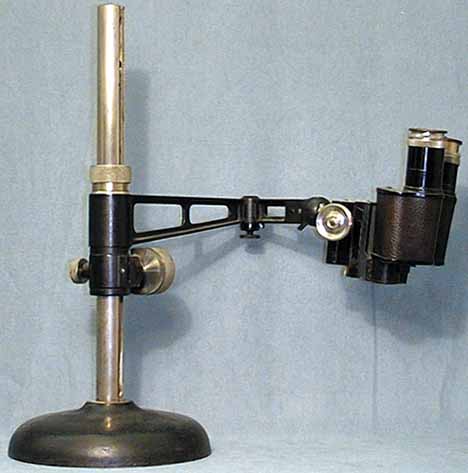
Greenough type "binocular" microscope; 10.5 x with two a15 oculars (1 1/4" diameter). The body consists of two binocular like leather covered tubes, 6" long, enclosing porro prism erecting optics, which may be rotated to accommodate inter ocular distance. The body is mounted through a brass dovetail to a focusing rack which is in turn mounted through a second dovetail to the arm (the rack may be removed). An 11" articulated black painted brass arm rotates 360° on a focusing sleeve which rides on a 14" pillar with rack and pinion movement. The pillar is attached to a heavy, solid, round cast iron base, 7" dia x 1 3/4" high at post. All exposed metal parts are nickel plated or black wrinkle enameled. There is a serial number? (6420) stamped on a plate on the top of the optical module focusing/mount mechanism.
Its operation is similar to the original potentiometer. It was invented by Samuel Hunter Christie in 1833 and improved and popularized by Sir Charles Wheatstone in 1843. One of the Wheatstone bridge's initial uses was for the purpose of soils analysis and comparison." (http://en.wikipedia.org/wiki/Wheatstone_bridge; downloaded from Wikipedia 06/27/2012)
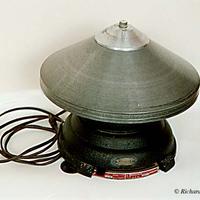
The centrifuge has a heavy, six place, cast aluminum, 10 1/2" angle head which doubles as a shield. It is enclosed beneath by a fitted spun aluminum cover for additional protection. There are six brass shields to fit 13x100 mm test tubes. The shields are made from tubing with rolled lips and soldered on bottoms. There is a small, conical, spun, aluminum cap covering the top of the rotor which attaches via a knurled screw to the shaft of the machine. The rotor is held on the motor shaft with a knurled screw which in turn has a threaded hole for securing the cap. The motor is mounted in a heavy cast iron base (7 1/2" dia. at base) finished in black crinkle paint. The instrument is 9 1/2" high. Speed is controlled with a Bakelite lever riding in a slot at the front of the housing. "OFF" and HIGH" are cast in raised letters at either end of the slot in the housing. It has a brown, two-wire, lamp-type cord Below the slot (and covering its entire length) is an aluminum tag with a frame and lettering in polished metal against a red background. OFF and HIGH are repeated on the tag with arrows) then serial [3348, stamped] then PHILLIPS / ST. LOUIS then, in a center red box, P / d, then DRUCKER / U. S. A., then volts [120, stamped]. There is a brass tag: HUMBOLDT-S-C 10021.
The aluminum and brass parts were mildly corroded and dirty when acquired. The rotor was removed, disassembled and cleaned with a brush. It was then treated with Briwax and steel wool to remove loose corrosion and to seal the metal, and then polished with a cloth. The Brass shields were also cleaned with Briwax and polished with a cloth. The painted housing with cleaned with a brush and then wiped and polished with Pledge using a towel.
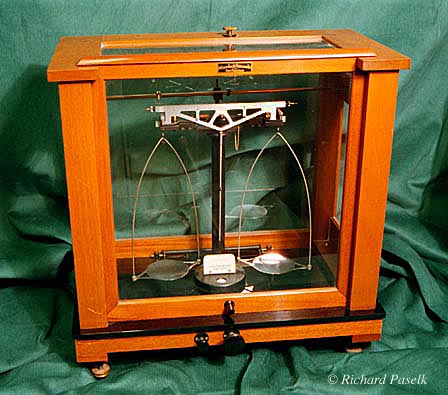
The balance has a 6 1/2" polished aluminum beam graduated in black figures from 0 to 5 mg by 0.1 mg to both sides of the center. There is a 5 mg wire rider. The balance has knife edges on planes for the beam and both pans. The rider carrier is a wire "T" on a chrome plated rod attached to a sliding brass rod manipulated through a grommeted hole in the wood case on the right side of the balance. The beam is supported by a simple black painted column on a square black painted base plate bolted to the glass base of the balance. There is a white plastic scale attached to the front of the brass base plate graduated in red and labeled: CHRISTIAN BECKER. There is a single bullseye level inlet into the column base in front of the plastic scale. The release mechanism operates on both the beam and the pans. The pans are arrested through a second knob mounted below the heavy (1/2") black glass base, 16 1/2 x 9 1/4". The aluminum pans are supported by chrome plated brass bows and double hook hangers. The balance rests on a single rear post and two leveling screws operating brass disks set into the mahogany sub-base. The balance is enclosed in a glazed mahogany case, 16 1/2w x 13 1/2h x 9", with sliding door at the front. The instrument and case have been cleaned and waxed or oiled as appropriate. The case has a brass plaque stamped "Serial number B - 44713" on the lower front right side corner of the wooden base. At the time of acquisition there was a card tag wired to the right front leveling screw stamped "1954." There was in addition a decal labeled "State of California/Humboldt College/36461" affixed to the wood base on the lower left side beneath the black glass table. The balance was listed in the 1987 Physics/Physics Shop inventory.
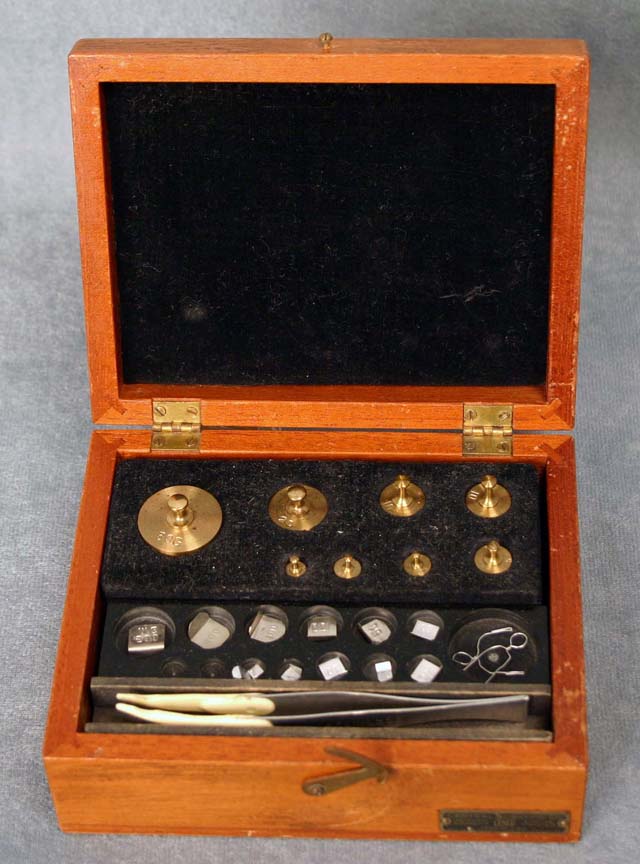
This is a student grade weight set, used for routine mass determinations in conjunction with an analytical balance. The quality of this set would indicate its intended use in beginning chemistry or physics courses. Such sets might also find use commercially for routine work.
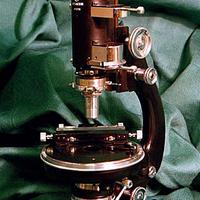
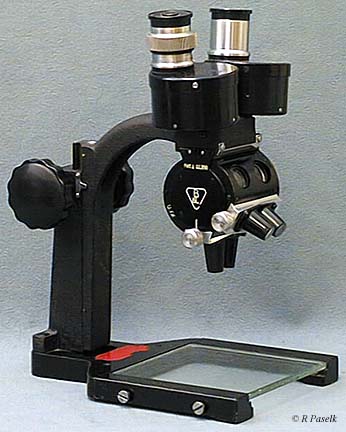
The microscope stands 9" high when closed, the base is 5 1/4" wide by 7 1/8" deep. It is scribed HSC 43765 on the right-hand stage-bracket and the right-hand prism cell next to the B&L logo and serial number (TP 484). The stand is finished in black crinkle-paint, while the base and optical head is black japanned. The 0.7x objectives are built in to the drum nose-piece. Two additional sets of objectives, 1.5x and 2.0x, are on dove-tail sliders. Both eyepieces are replacements as is the glass stage.
The thermometer is a Cenco model No. 19410 (made in Germany). It is 57.5 cm in overall length, with a 35.5 cm long milk glass baking inside the large tube. There is a nickel cap on top made of straight tubing to which a flat, knurled-edge top with a small turned knob in the center is soldered. The thermometer is graduated from -0.1 to 6.1 °C by 1/100 °C on the main scale, and from -9 to 144 °C by single degrees on the upper "setting" scale. The upper scale has every 10 degrees numbered (obviously by hand), while the main scale is numbered every 0.2° with larger numbering at each degree.
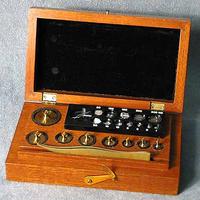
Class S-1 lacquered brass 1–50 gm, tantalum 50–500 mg fractional weights, aluminum 1–10 mg fractional weights, and two aluminum wire 10 mg riders. The set is complete including forceps (replacement).
The 5" x 4" x 2" wood box is of lacquered mahogany (see linked photo). The box is of mitered corner construction lined with black velvet., and a black plastic tray for factional weights. The box hardware is brass. There is a black and nickel plated CENTRAL SCIENTIFIC COMPANY tag on the lower right corner of the front of the box with raised letters. There is a partial decal: STATE OF CALIFORNIA / HUMBOLDT COLLEGE / 11450 and a number 2 on embossed tape, both on the box lid.
The instrument stands 11.5" high in the closed, vertical position. The base is of cast iron with black crinkle finish, some of which has come off to expose the iron below the mirror rail. The scale and readout arms are of steel. All of the control knobs and the alidade handle are in heavy chrome plating. The solid metal two sided mirror is mounted on an adjustable dovetail slide. The scale is engraved on an inlayed german silver strip with scale divisions to the thousands place (nD 1,3001,710), and numbered to the hundreds place. The number: 788432618 is engraved on the scale just past 1710. The readout is viewed with an adjustable triplet magnifier. A hairline engraved on a glass window affixed via a threaded retaining ring to the prism alidade determines the index. The prism alidade has a tangent screw fine adjustment. The refractometer telescope is heavy black enameled brass, with the AO shield logo engraved and white filled on the arm over Spencer and the serial number: 2009. The Amici color compensating prism scale is finished in brushed chrome with black filled engraved divisions (0-60-0) and adjusted with a knurled wheel. The prism holder is finished in brushed chrome with polished chrome tubulatures for connecting to a circulating bath for temperature control. There is a chromed brass thermometer shield and mercury-filled thermometer. Engraved: HSU 43923.
The instrument has its original black leatherette covered hardwood case and its original glass block refractive index standard in a small plastic vial (shown in the photo).
The microscope stands 340 mm high when closed. The heavy, cast iron, stand measures 103 mm from the optical axis to arm at stage level, and 132 mm from table to the stage. The fine adjustment is graduated to 0.0025 mm. The microscope is equiped with optical quality polaroid analyzer and polarizer. The stage is 125 mm in diameter with the periphery graduated in degrees, and readable by a vernier to three minute os arc. The instrument is complete with a gray leatherette covered carrying case with an AO Spencer No. 495 Graduated Attachable Mechanical Stage in a case, and a case for accessories, containing: four compensators (full-wave plate, 1st order red.; quartz wedge, I to III order; quarter wave plate; Becke aperture plate), three objectives (2x, 10x, & 43x) mounted on No. 463 objective centering rings (with 2 adjusting wrenches), two standard size cross-hair eyepieces (6x & 10x), and a pinhole eyepiece.
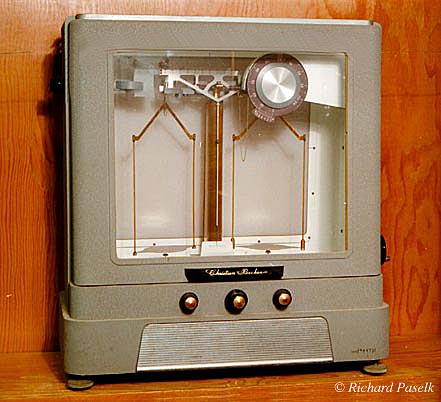
This is Christian Becker's top-of-the-line Chainomatic analytical balance. The aluminum case is gray crinkle finished with nickel plated (now corroded on the outside) trim. There are glass panels on the front and top, with a translucent opal glass panel on the back. The plate is black glass setting on a cast aluminum base.l. The case is 20"h x 18 1/4"w x 9"d. There is a drawer in the base. The balance has stainless steel pans on polished brass, 3-piece, hangers. The column is enclosed in a polished brass sheath. See catalog descriptions for additional details. (Property tag: State of California/ 43910). As seen in the enlarged image, a nickel-plated black-painted brass tag attached to the back of the balance case provides the style (AB-2), capacity (200 g) and serial number (A 4731). A small cardboard box (3 5/8" x 2 5/8" x 1/2") originally containing the chain for this balance was found in the balance drawer. Original wrappings etc. were still in the box as shown in the image.
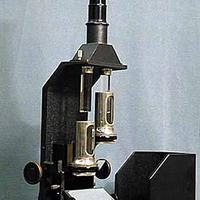
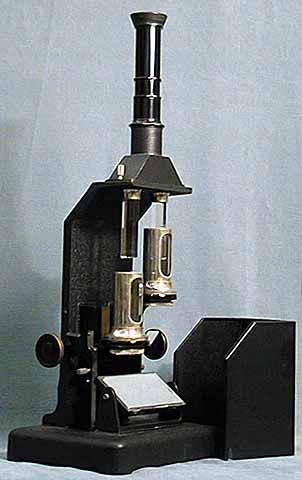
The instrument stands 16" high (drawtube closed) on a hollow 5 x 6" cast iron base. The stand is also cast iron, with a fold-up cast iron handle on the back. The prism housing/telescope mount is cast brass, attached with nickel-plated brass knurled screws. The sample cups (55 mm deep) are glass in nickel-plated brass shields (total height 72 mm). Each cup is held in a bracket on a focusing rail with a 60 x 1 mm scale read against a 0–10 vernier scale. Small mirrors mounted at 45° allow viewing the scales from the telescope eye-position. The hexagonal glass prisms are 55 mm long with an optical finish on all surfaces. The optical shield is formed of steel sheet. The mirror illuminator may be flipped over to give a flat white surface instead. A black enameled aluminum tag on the back of the stand reads, in raised metal letters:
BAUSCH & LOMB OPTICAL CO
ROCHESTER NY USA
NO 2451
with the serial number stamped on a blank metal field.
The instrument is supported by two tapered iron pillars, to give an overall height of 16" on an oval cast iron base (6 1/2 x 13 1/2"), all in black crinkled finish. The 4.75" readout circle is graduated in degrees, with a vernier readout to 0.1° observed through a magnifier, and illuminated via a small adjustable mirror. Original decal (now removed): State of California/43919.
The microscope stands 9" high when closed, the base is 5 1/4" wide by 7 1/8" deep. It is scribed HSC 43765 on the right-hand stage-bracket and the right-hand prism cell next to the B&L logo and serial number (TP 484). The stand is finished in black crinkle-paint, while the base and optical head is black japanned. The 0.7x objectives are built in to the drum nose-piece. Two additional sets of objectives, 1.5x and 2.0x, are on dove-tail sliders. Both eyepieces are replacements as is the glass stage.
Greenough type "binocular" microscope; 10.5 x with two a15 oculars (1 1/4" diameter). The body consists of two binocular-like leather covered tubes, 6" long, enclosing Porro prism erecting optics, which may be rotated to accommodate inter ocular distance. The body is mounted through a brass dovetail to a focusing rack which is in turn mounted through a second dovetail to the arm (the rack may be removed). An 11" articulated black painted brass arm rotates 360° on a focusing sleeve which rides on a 14" pillar with rack and pinion movement. The pillar is attached to a heavy, solid, round cast iron base, 7" dia x 1 3/4" high at post. All exposed metal parts are nickel plated or black wrinkle enameled. There is a serial number? (6420) stamped on a plate on the top of the optical module focusing/mount mechanism.