-
Title
-
Alluard Dew-Point Hygrometer
-
History / Usage
-
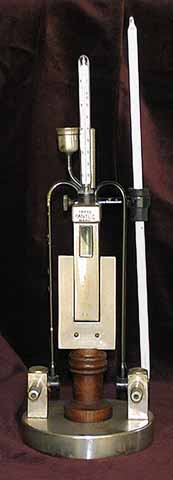
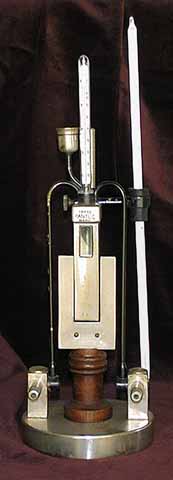
The dew-point hygrometer exemplifies one of the standard methods for the precise determination of relative humidity. It is operated by placing a volatile fluid, such as ether, into the central chamber, and blowing air through it via the tubes on the base to cool the apparatus by evaporation. This is done until condensation forms on the central chamber, as observed relative to the comparison metal 'U.' The temperatures of the two thermometers are then read and the humidity determined using a standard table.
-
Description
-
tand is heavy brass, 4 1/8' diameter x 3/4' thick with a 8 13/16' high 9/32' diameter rod, nickel plated, the brass showing through the plating in various places. The tubes leading to the chamber are black japanned, with some chipping. There is a japanned brass clamp for the reference thermometer. The chamber is mounted above the base on an insulating pedestal of turned hardwood (mahogany or rosewood?). There are windows front and back in the chamber to determine the level of the ether coolant.
Both thermometers are replacements. The chamber thermometer was discarded by a plant physiology lab at UC Berkeley, apparently from electrochemical apparatus. The reference thermometer is a recent Cenco standard lab thermometer.
-
producer
-
Pantechnical Mfg. Co.
-
Date Created
-
c.1930
-
Is Part Of
-
Humboldt S-T-C
-
Subject
-
Hygrometers; dew-point measurement; humidity; meteorological instruments
-
References
-
W. M. Welch Manufacturing Company Instructions for the use of the No. 1725 Alluard Hygrometer (1930)