-
Title
-
Slide Rule, Demonstration, Overhead Projector
-
History / Usage
-
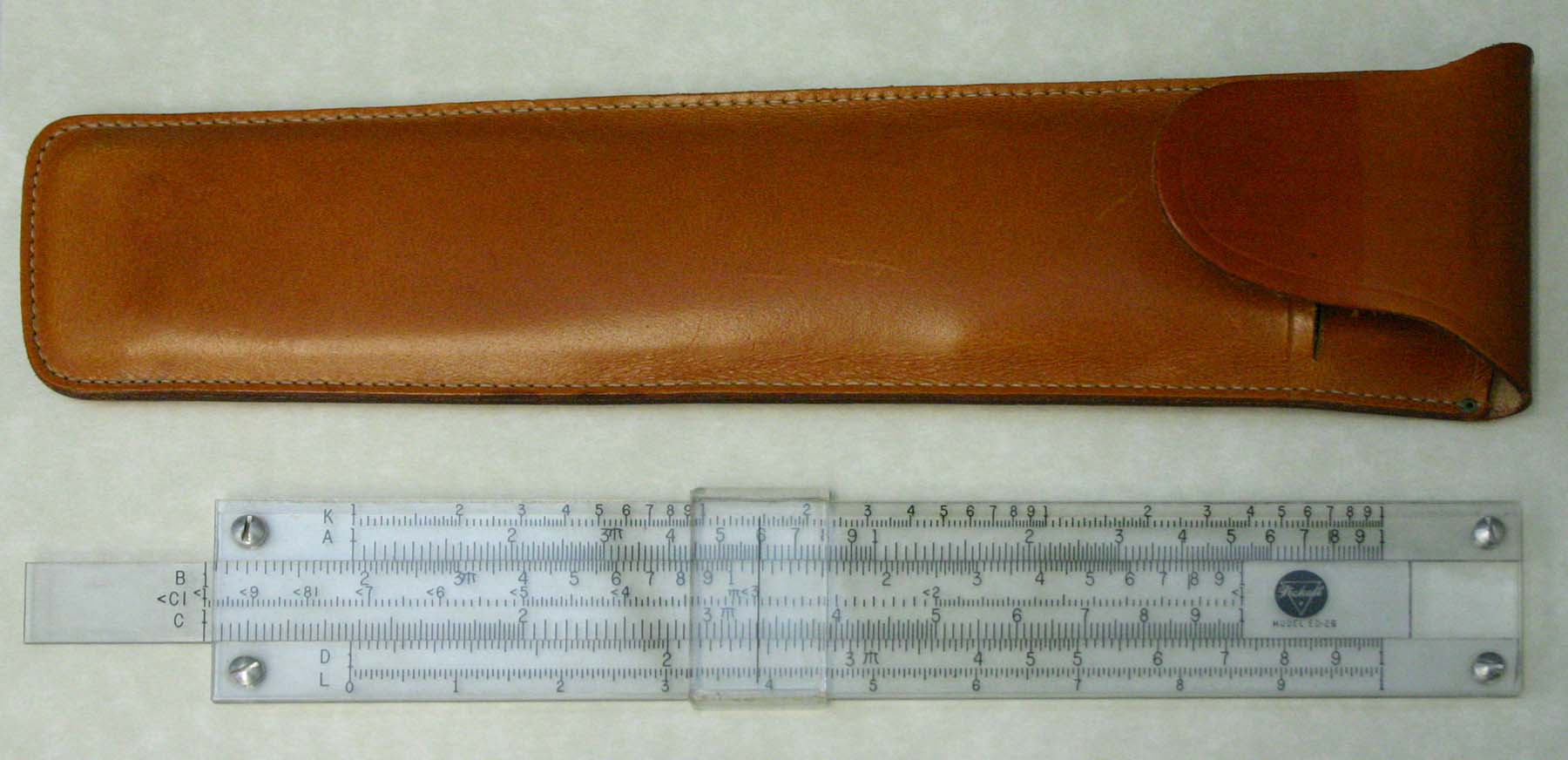
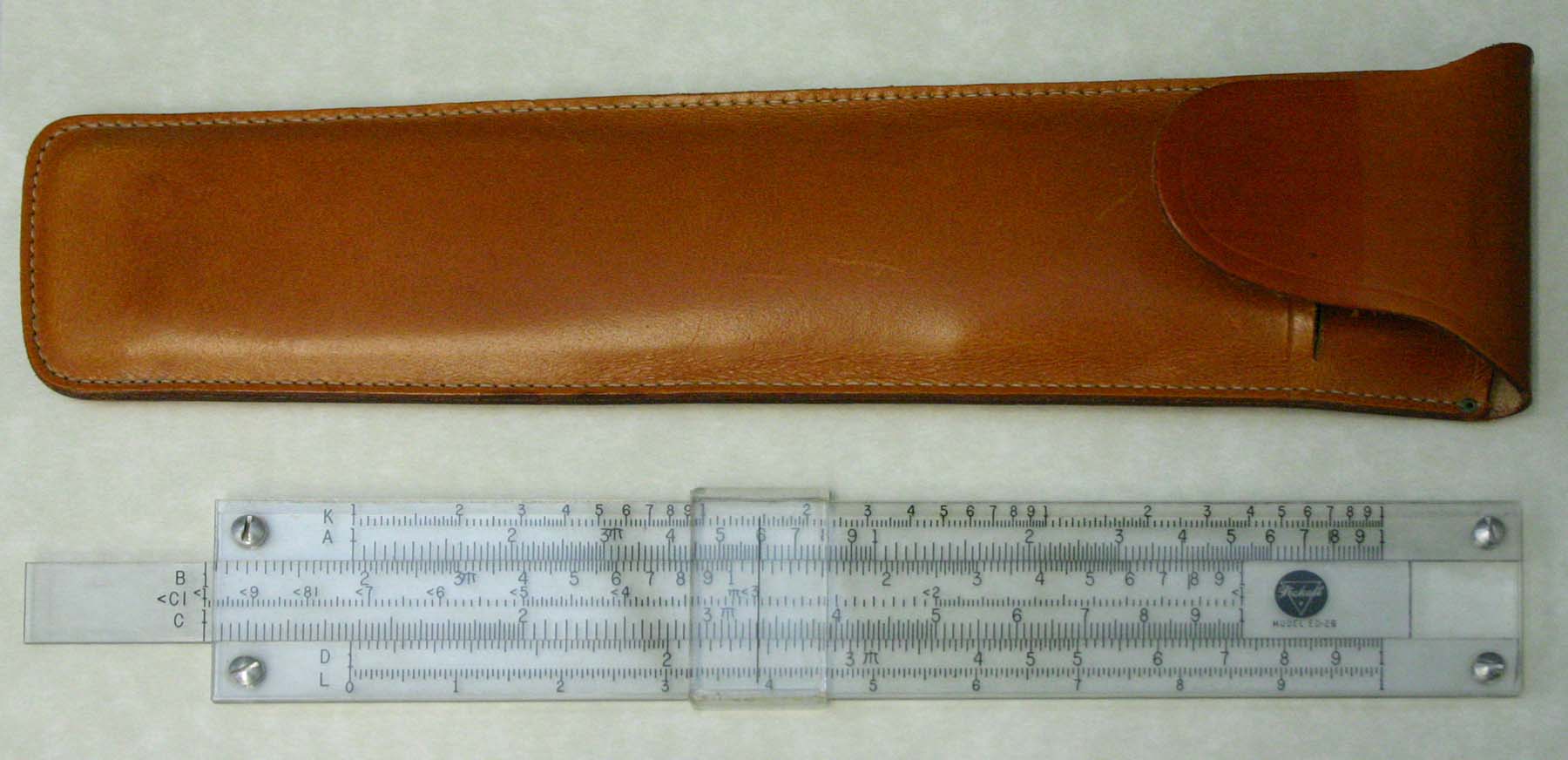
Slide rules are devices used to aid in calculation, and were extremely important tools in science and engineering prior to the development of the hand calculator. Because of their importance instruction in the use of the slide rule was routinely given in Chemistry, Physics, and Engineering classes, frequently using large demonstration rules such as the one seen here. In essence a slide rule works by, 1) adding and subtracting the logarithms of numbers on adjacent sliding scales thereby enabling multiplication and division (log a*b = log a + log b, log a/b = log a - log b), and, 2) comparing various different parallel scales (in essence acting as tables of trigonometric functions, logarithms etc.).
This particular slide rule was used in the Physics department at Humboldt. An identical projection rule was held by the Chemistry department. In both departments large demonstration rules were also in use (in Chemistry large rules were mounted in both labs used for general chemistry, an early 8 foot K&E version from the 1930's and a seven foot Pickett rule), while Physics had a number of Pickett rules, including both four foot and seven foot versions. The projection rules were probably obtained in the 1960's for use in lecture rooms as the overhead projector became a standard teaching tool in most lecture halls.
The idea of using a logarithmic scale for calculations began with Edmund Gunter when he engraved a scale of logarithms on a piece of wood in around 1620 and used a dividers to add and subtract them to or from each other, and thus multiply and divide. In 1632, William Oughtred devised a pair of sliding scales, which when applied to each other could be used to multiply and divide. It wasn't until 1850, however that the modern form of the slide rule, with one rule sliding between two others, and using a sliding cursor, was devised by Lt. Amédée Mannheim. The resulting "Mannheim" slide rule carried the A, B, C, D, S, T, and L scales on a wooden rule. White celluloid was used in slide rules by 1886. In 1887 Keuffel and Esser began the manufacture of slide rules in the U.S. using mahogany with celluloid scales. Before this time slide rules had to be imported. In 1891 the "Duplex" slide rule, carrying folded scales, was devised by William Cox and manufactured by K&E, and by about 1900 the Log Log Trig slide rule took its "final" form.
-
Description
-
The body of the rule is 9" long. It is made from three layers of clear plastic (perspex) with the slide fitting between the top and bottom layers and the upper and lower segments of the central layer. The three layers are held together with aluminum screws at each corner. A separate clear plastic cursor slides in two groove formed between the top and bottom layers. It is accompanied by its original leather case.
The basic history of the slide rule is outlined in Michael R. Williams, A History of Computing Technology, Prentice-Hall, Inc., 1985, pp. 111-118 and John P. Ellis, The Theory and Operation of the Slide Rule, Dover Pub. Inc., New York, 1961, pp. 247-250. An extensive history of the slide rule is found in A History of the Logarithmic Slide Rule and Allied Instruments by Florian Cajori, The Engineering News Publishing Co., New York (1909) [recently reprinted].The patent number corresponds to 1937, thus 1937 is the earliest possible date for this rule. Two more recent and excellent treatises are the books by Dieter von Jezierski, Slide Rules: A Journey Through Three Centurie, Astragal Press, Mendham (2000), and Peter M. Hopp, Slide Rules: Their History, Models, and Makers, Astragal Press, Mendham (1999).
* According to Hopp (1999, p210), the Pickett ED-26 projection rule was made by Projection Optics Company, Inc.
-
Is Part Of
-
HSC 1956-72 Instrument Collection
-
References
-
The basic history of the slide rule is outlined in Michael R.