Standard Cell, Weston model 4
of 1
- Title
- Standard Cell, Weston model 4
- History / Usage
-
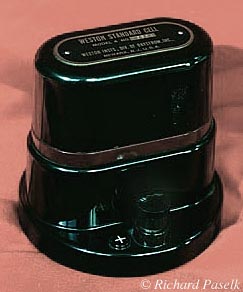
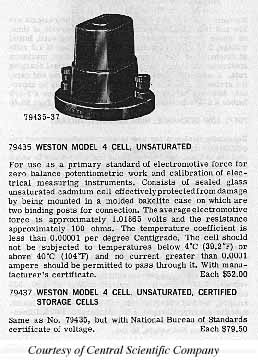
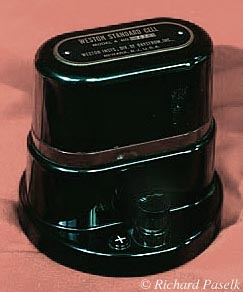
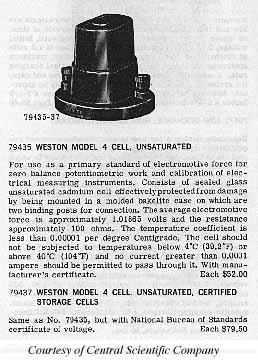
Unsaturated Weston cells, such as this example, are the most common voltage standards in normal laboratory use. This specimen represents a style going back to at least 1929. These cells show a small temperature coefficient and so are normally preferred over the saturated Weston cell. However their E.M.F. decreases by about 0.08 mv per year, and thus must be calibrated periodically against a saturated Weston cell at a defined temperature. The Weston cell may be diagramed as:
Cd(Hg) | CdSO4(aq), Hg2SO4 | Hg.
standard, the Clark cell. It also had the advantage of producing a voltage very near to one volt: 1.0183 V. In 1911 the Weston Saturated Cadmium Cell became the International Standard for electromotive force. Weston waved his patent rights shortly afterword so anyone was allowed to manufacture it. - Description
- The circular base of the cell is 4 3/16" dia. and the cell is 3 7/8" high. There is a metal tag on the top of the cell which reads: WESTON STANDARD CELL / MODEL 4 NO. 19866 / WESTON INSTS., DIV. OF DAYSTROM, INC., / NEWARK, N.J., U.S.A. There is a decal under the cell: Dec. 21 '59. Includes National Bureau of Standards Certificate, (80k) dated March 1, 1960, and Weston Instruments Certificate, (132k) dated February 26, 1960 for this cell: number 19866. (Humboldt College decal: 30642, now removed.)
- Includes National Bureau of Standards Certificate, (80k) dated March 1, 1960, and Weston Instruments Certificate, (132k) dated February 26, 1960 for this cell: number 19866.
-
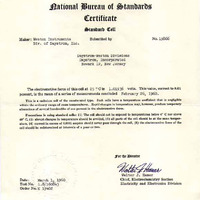 Certificate - Standard Cell, Weston model 4
- Creator
- Weston Inst. Div. of Daystrom Inc.
- Is Part Of
- HSC 1956-72 Instrument Collection
- References
-
Woodbury, Edward O. A Measure for Greatness: A Short Biography of Edward Weston. McGraw-Hill Book Company, Inc. New York.
- Abstract
- Unsaturated Weston cells, such as this example, are the most common voltage standards in normal laboratory use.