-
Title
-
Standard Cell
-
History / Usage
-
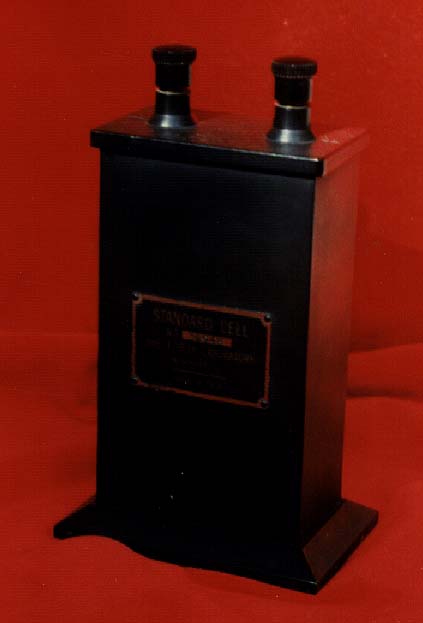
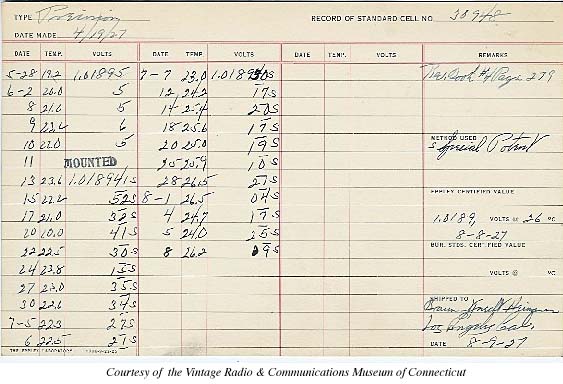
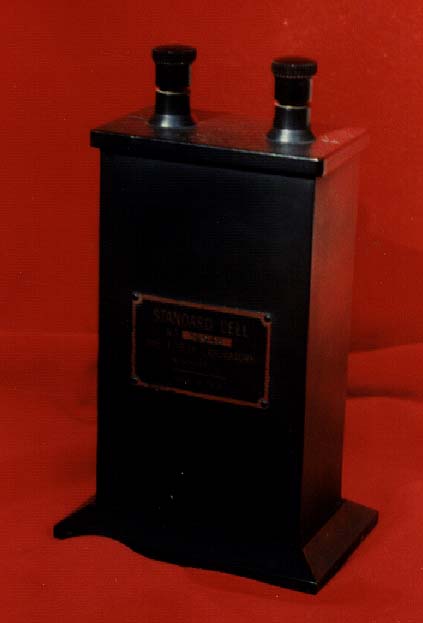
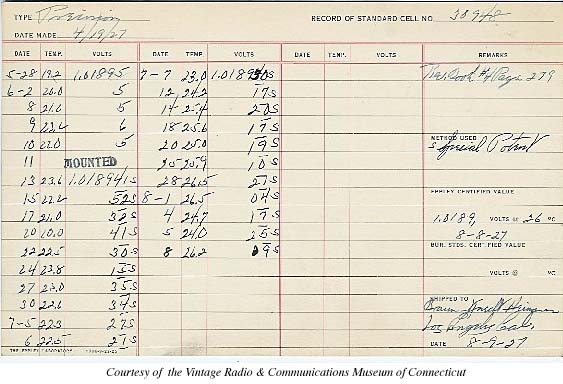
Unsaturated Weston cells such as this example are the most common voltage standards in normal laboratory use. These cells show a small temperature coefficient and so are normally preferred over the saturated Weston cell. However their e.m.f. decreases by about 0.08 mv per year, and thus must be calibrated periodically against a saturated Weston cell at a defined temperature. The Weston cell may be diagramed as:
Cd(Hg)CdSO4(aq), Hg2SO4Hg.
-
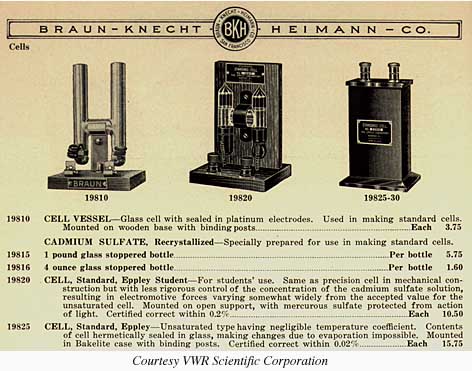
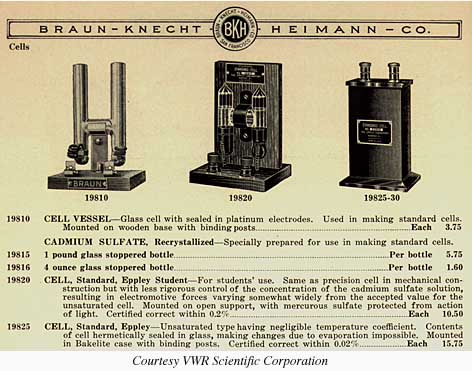
Some contemporary/early descriptions of the standard cell and its use are provided below:
Standard Cells.... Duff, A. Wilmer. A Text-Book of Physics (1921)
Standards of Electromotive Force. The Epply Laboratory (c.1922)
-
Description
-
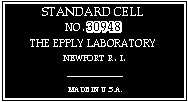
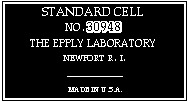
The cell stands 7 1/2" high to the top of the binding posts, 6 3/8" to the top of the Bakelite case lid. The case itself is a 3 3/8 x 1 7/8 x 3 5/8" hollow Bakelite tube, setting on a bevel edged 4 3/8 x 2 13/16 x 1/2" base, and with a 3 5/8 x 2 1/8 x 1/4" top with binding posts marked - & + in raised symbols. There is a black and nickel plated brass plaque pinned to the front, approx. as shown in the drawing below: