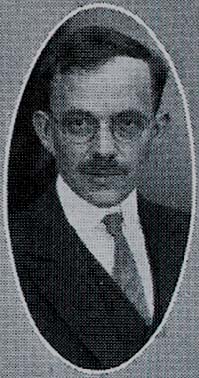
Bachelor of Accounts, International Business College, South Bend, Indiana, 1908; B.S., Indiana State Teachers College (Eastern Division) 1911; A.B., University of Indiana, 1915; A.M., University of Chicago, 1917; additional graduate study, University of Chicago, 1917, Stanford University, 1924. Teacher in rural schools1905-9; Principle of consolidated township high school, Carroll County, Indiana, 1911-14; Instructor in Mathematics and Coach Basketball, Central High School, Elkhart, Indiana, 1915-16; Instructor in Mathematics, Central High School, Kalamazoo, Michigan, 1917-18; Principle, Central High School, Kalamazoo, Michigan, 1919-20; Head, Department of Education and Psychology, New Mexico State Normal School, 1920-21. Member of Phi Delta Kappa. At Humboldt since 1921.
The slide rule is made of wood (Redwood was the preferred material due to its light weight and strength) with white enamel on the front surfaces; it is unfinished on the sides, ends, and back. The rule is 84 1/2" long x 7 5/8 inches high by 1 1/2 inch thick. There are four one inch finger holes in the slider to allow the demonstrator to slide it relative to the other scales. All divisions, numbers, etc. are in black enamel with the exception of the CI scale whose numbers are in red. KEUFFEL & ESSER CO. N.Y is printed in bold 1" letters in the center of the top portion of the rule, while to the left in 1/4" letters is written: PAT. JUNE 5, 1900, and to the right, again in 1/4" letters is: MADE IN U.S.A. and MODEL 100. The original cursor window (cellulose nitrate? with an engraved line filled with black paint) fragmented and has been replaced with clear acrylic. An eyebolt is attached to the top of the rule above each end of the A scale. A Chem Dept decal is on the top, front of the rule above "24" on the A scale. An oval brass tag, attached with brass pins to the right end of the rule, is stamped: HUMBOLDT S-T-C / 2094.
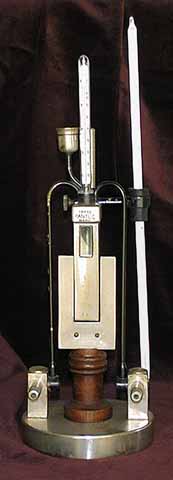
tand is heavy brass, 4 1/8' diameter x 3/4' thick with a 8 13/16' high 9/32' diameter rod, nickel plated, the brass showing through the plating in various places. The tubes leading to the chamber are black japanned, with some chipping. There is a japanned brass clamp for the reference thermometer. The chamber is mounted above the base on an insulating pedestal of turned hardwood (mahogany or rosewood?). There are windows front and back in the chamber to determine the level of the ether coolant.
Both thermometers are replacements. The chamber thermometer was discarded by a plant physiology lab at UC Berkeley, apparently from electrochemical apparatus. The reference thermometer is a recent Cenco standard lab thermometer.
The body of the instrument is about 45" long and 5" wide, made of steel angle-iron rails bolted to cast iron open-work end-pieces. There is a 12" long sheet-steel sound box at the tail end with a black stained hardwood bridge located with brass pins and held in place by the strings of the instrument 20 cm before the opening of the sound-box. The frame and sound-box are all painted in gray wrinkle-finish enamel. A white-enameled steel sheet begins at the opening of the sound-box and extends to the end of the instrument. A central scale runs from 20–100 cm by 0.1 cm with each cm graduation numbered. Diatonic and equally tempered scales are also marked, from C512–C128. At the top end of the instrument a cast-iron and steel rack extends another 9" and holds three adjustable spring scales with hooks to tension the three strings. Each scale is graduated (red filled engraving) from 0–20 units by 0.25 units, with even graduations numbered. The scales themselves are of brass with white-metal plating. Each scale is attached via a square screw with wing-nut for adjusting tension to the cast iron rack. With the springs fully tensioned the entire instrument would have a total length of 57 1/2". The original adjustable bridge of the instrument is missing: a custom wooden bridge has been substituted. The instrument is in excellent condition barring a pattern of pitting of the white paint on the scale with consequent corrosion, and a chip on the cast-iron of the scale rack.
There is a brass Humboldt S-T-C tag (4857) riveted to the upper left end of the scale.
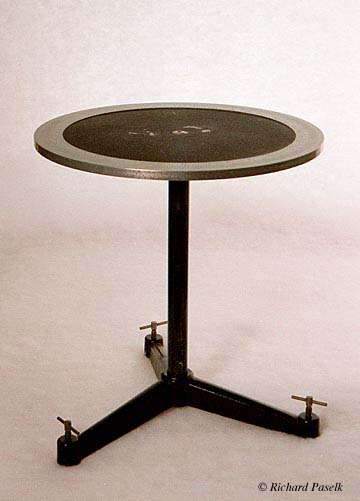
The instrument has a 15.5" diameter cast aluminum plate, 0.5" thick at the rim, with reinforcing ribs beneath. There is a machined, slightly raised rim 1.5 inches wide around the outside on which a 360° engine divided scale is inscribed. The inner portion of the plate is black crinkle-finished, with a nickel-plated brass insert with a 0.25" hole in the center. The plate is held on a 1 1/8" diameter steel rod which threads into a heavy cast-iron tripod base with nickel-plated brass leveling-screw feet on each leg. The rod and base are finished in heavy black enamel. The tripod legs of the base are 8.5" long. The overall height (minimum) is 17". A brass tag is pinned beneath the rim near the outer edge: HUMBOLDT S-T-C 2689. There is a Cenco decal on one of the tripod legs.
Three pulley assemblies are displayed with the force table, they may or may not be original to the table (they were the only three pulleys of this early style in the Physics Dept. inventory [donated 2012 when found during a stockroom cleanup]). Each assembly consists of a bronze casting, with index mark, finished in black enamel holding a nickel-plated pulley mounted with adjustable brass pivot-bearings (see photo of pulley assemblies). Three early 50 g weights and a black-enameled brass ring (all donated by the Physics Dept., 2012) are also displayed on the force table. As seen in the photo, each is somewhat different, one, originally black-enameled, has a hollow base filled with granular adjustment weights, the other two are solid brass, with most of the original nickel-plating now missing. The center post is a replacement metal rod.
The unfinished aluminum on the rim and edge of the plate were heavily corroded when the instrument was acquired. The corrosion was removed by rubbing with fine steel wool and Briwax, followed by polishing with a soft cloth. The painted surfaces were cleaned by vigorous rubbing with a cloth and Briwax, then polished with a soft cloth. There is some flaking of the crinkle finish on the plate, and some chipping of the enamel on the stand.
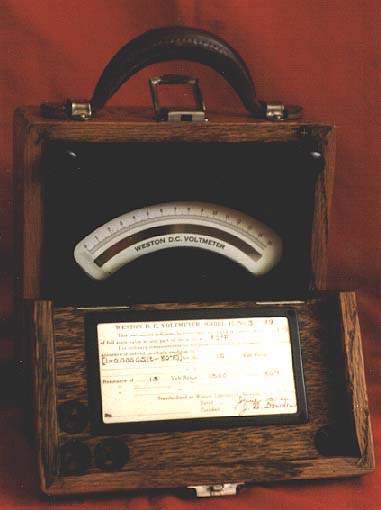
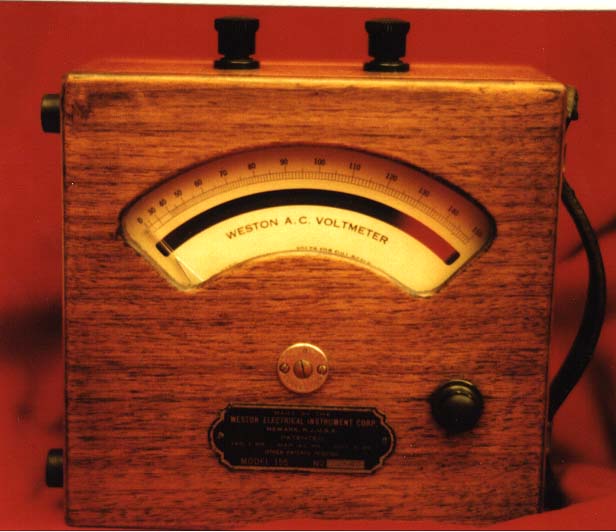
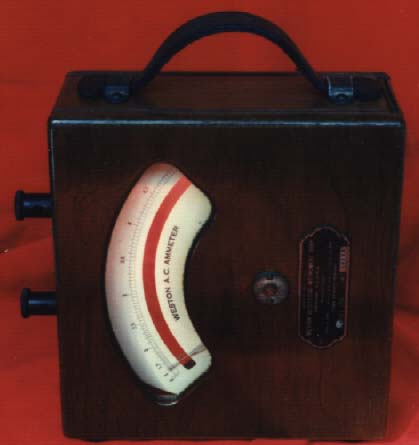
The instrument is housed in a 7.75 x 7.75 x 4.5" oak case with a leather handle. All hardware is nickel-plated brass. The front panel and meter face plate are of heavy cast iron with a fine diamond pattern on the casting. Iron parts have a "japanned" black enamel finish. The binding posts are of black Bakelite. The meter has a mirrored scale. The serial number is hand written on the white scale behind the face plate. The top screw holding the face plate in place is sealed with sealing wax(?) and stamped with a "W." There is a brass plate finished in black and nickel plating attached to the front of the cabinet below the door:
MADE BY THE
WESTON ELECTRICAL INSTRUMENT CO.
NEWARK, N.J., U.S.A
PATENTED
NOV. 6, 1888 MAY 14, 1889 APR. 29, 1890
FEB. 17, 1891 DEC. 19, 1893 OCT. 4, 1898
JUL. 18, 1901
MODEL 45 NO 31789
Beneath this plate is a brass escutcheon labeled "0 CORRECTION" giving access to the zero correction screw.
There is a calibration sheet held under acetate in a black painted brass frame inside the door. It is signed and dated: June 15, 1926. There is an oval brass tag attached with brass brads left side of instrument stamped HUMBOLDT S-T-C / 2100.
The oak case has been stripped and refinished with "Watco Danish Oil," all exposed metal parts have been acid cleaned and lightly polished. Bakelite, painted metal, and rubber parts have been cleaned and polished with furniture polish, and the leather handle has been treated with neatsfoot oil.
The instrument is housed in a 7 1/8 x 6 3/4 x 3 1/4" walnut case with a leather handle on top. All hardware is nickel-plated brass. The front panel has a window cut into it to view the meter face. The meter has a mirrored scale. The serial number (32646) is hand written on the white paper scale behind the face plate. The two screws in the side of the case allowing access to the movement are sealed with black sealing wax(?) and stamped with a "W." The instrument has four rubber feet on the bottom for storage and four more feet (one missing) on the back for use during operation. There are two Bakelite binding posts on the left side of the instrument's case, and a momentary contact switch with a vulcanite button on the lower right side of the front.
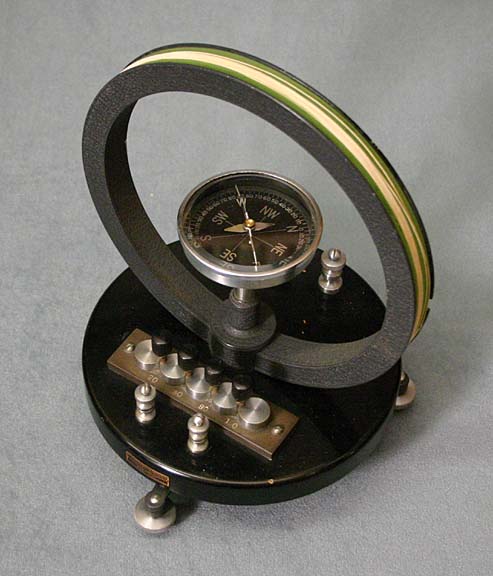
The windings (20, 40, 80, and 160) are wrapped in a U-shaped channel in an 8 7/8" o.d. cast aluminum ring. Slots in the back of the ring allow the coil diameters to be measured. There is a 3 1/4" diameter chrome finished compass with raised polished metal numbers and divisions against a black plate, mounted on a center rod centered in the coils, the whole mounted in the center of an 8" diameter black painted wood base. Two chromed brass posts at the front of the base connect through contact plugs on a hard rubber rectangle on the base. An additional set of heavy coils are provided with separate binding posts at the back of the instrument. The entire instrument is mounted on a heavy cast brass tripod equipped with leveling screws. The tripod and ring are finished in black wrinkle enamel. Humboldt S-T-C brass tag: 3877.
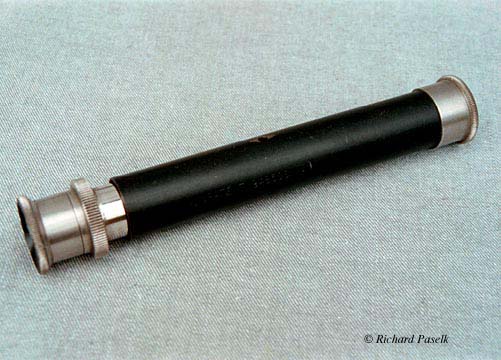
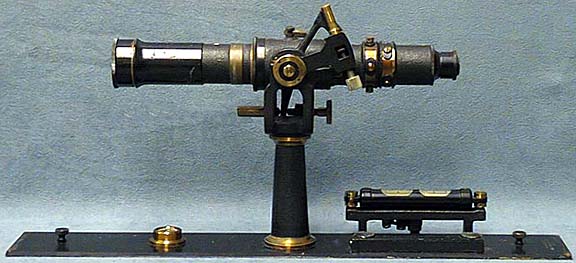
The telescope is 5 3/4" (149 mm) long (closed) and 1" (25 mm) dia. The barrel is black painted brass with polished, nickel plated, objective holder and eyepiece. Two holes (1/8", 4 mm) on opposite sides of the center of the barrel allow mounting in the telescope holder. Stamped on the barrel: PATENT 1948588. The eyepiece is 2 3/4" long, including a 1 7/8" focusing barrel, which slides in a cloth lined segment of the telescope barrel. The eyepiece has a single cross-hair, focused by turning a knurled focusing ring close to the barrel end. The cement in the cemented achromatic objective lens has failed.
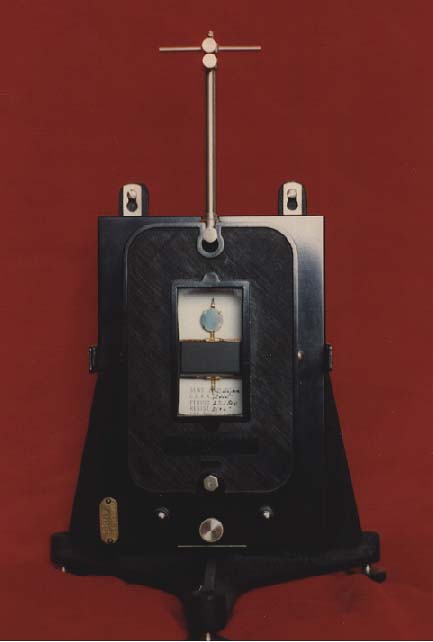
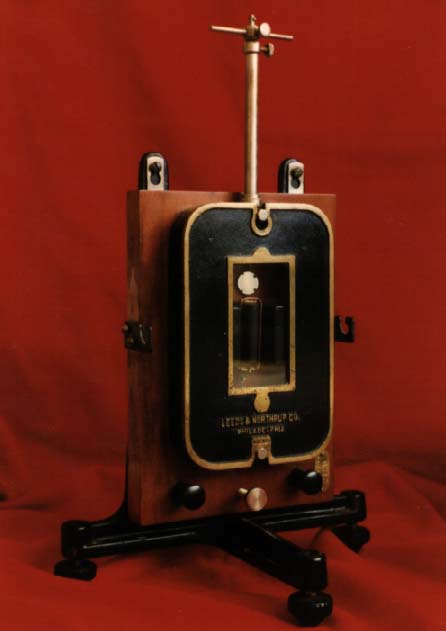
L&N Type P, Ballistic, student grade moving coil reflecting galvanometer, serial number 730967. The meter consists of a 7 1/8 by 4 5/8 by 7/8" magnet covered by a Bakelite plate with a center 1 3/4 by 3 3/8" window and with a hollow suspension post of nickel plated brass (4 1/4 by 3/8") on top. The L&N logo is in raised letters against a black polished region on the diamond stippled background of the Bakelite cover. There are raised polished borders around the edge and the window. The mirror is 5/8" dia. There is a white backing inside the meter with the following characteristics noted (data hand entered) SENS. .0018uc/mm, C.D.R.X. 12000'~, PERIOD 27.2 Sec, RESIST 2146~, CAT. NO. 2239D. The meter is mounted on 6 1/4 by 9 by 7/8" Bakelite backboard with two nickel plated brass hangers at the top, two black painted telescope arm brackets on the sides, two Bakelite binding posts at the bottom on either side of a leveling screw, a manufacturer's label on the bottom edge and a brass Humboldt S-T-C tag (4925) on the lower left hand corner.
The meter is mounted on a galvanometer base, Tripod, L&N 2126, made of cast iron, identical, with the exception of the crinkle finish, to item 82315, pg. 742 of the 1960 (J-300) Cenco catalog. An essentially identical base had a decal labeled: State of California/Humboldt College/11xx1.
The meter was damaged in the Dec. 1994 Humboldt County earthquake: the brackets were bent, and the upper suspension tube was snapped off at the base where it screws into the meter frame. The brackets were subsequently straightened. However the tube is held in place by friction, and has not been repaired further.
L&N Type P, current, student grade moving coil reflecting galvanometer, serial number 102521. The meter consists of a 7 1/8 x 4 5/8 x 7/8" magnet covered by a bronze plate with a center 1 3/4 x 3 3/8" window and with a hollow suspension post of nickel plated brass (4 1/4 x 3/8") on top. The L&N logo is in polished raised letters against a black painted background, with raised polished borders around the edge and the window. The coil is stabilized with wax, the mirror is 5/8" dia. The meter is mounted on 6 1/4 x 9 x 3/4" mahogany backboard with two nickel plated brass hangers at the top, two black painted telescope arm brackets on the sides, two Bakelite binding posts at the bottom on either side of a leveling screw, a manufacturers label on the bottom edge and a brass Humboldt S-T-C tag (2120) on the lower right hand corner. The leveling screw is a replacement from a more recent model of the same instrument. The tripod galvanometer base is of heavy cast iron with a japanned finish. There are three brass & Ebonite leveling screws.
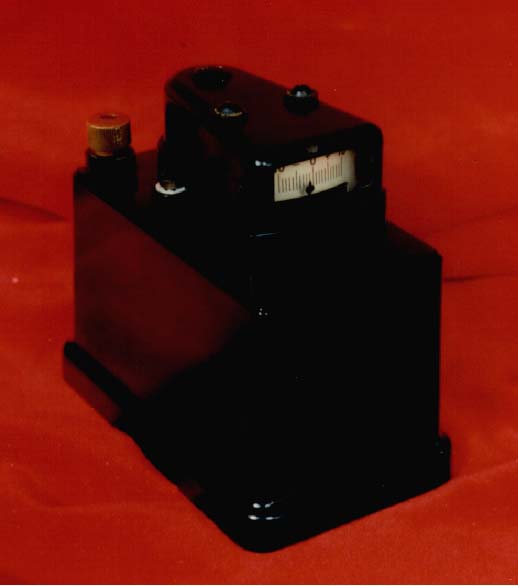
The instrument is housed in a 4 1/2 x 2 3/4 x 2 3/4 in Bakelite case with LEEDS & NORTHRUP CO. / PHILADELPHIA / MADE IN U. S. A. in raised letters within a rectangular depression on the case front. The meter display is in a 2 1/2 x 1 3/4 x 1 inch high wedge shape steel container mounted on top of the case. A 1/2 x 1 1/4 inch window in front exposes the -10-0-+10 graduated scale and pointer. Two brass binding posts are placed on the opposite top rear corners of the case.
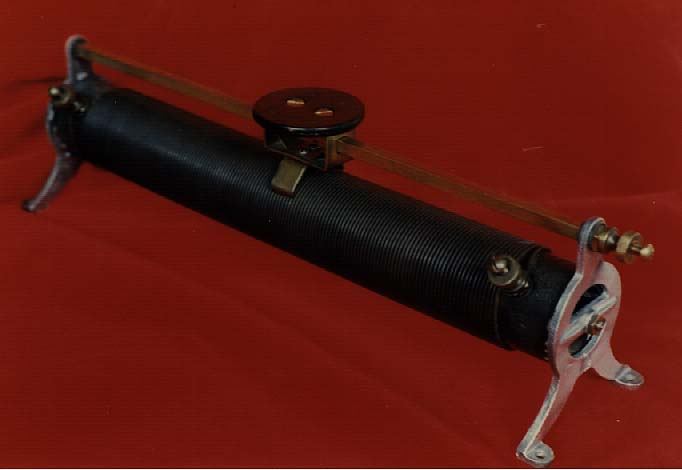
The rheostat is as described in the catalog description. The instrument is stamped "6 OHM" and "7.3 AMP" on the top of the Bakelite slider knob, corresponding to item A in the catalog description. The left rear leg is broken off.
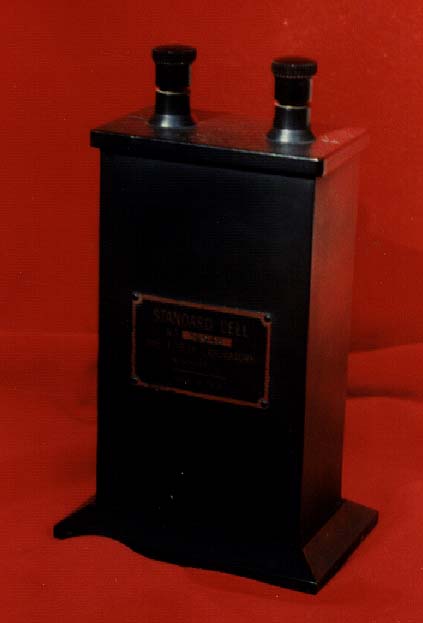
The cell stands 7 1/2" high to the top of the binding posts, 6 3/8" to the top of the Bakelite case lid. The case itself is a 3 3/8 x 1 7/8 x 3 5/8" hollow Bakelite tube, setting on a bevel edged 4 3/8 x 2 13/16 x 1/2" base, and with a 3 5/8 x 2 1/8 x 1/4" top with binding posts marked - & + in raised symbols. There is a black and nickel plated brass plaque pinned to the front, approx. as shown in the drawing below:
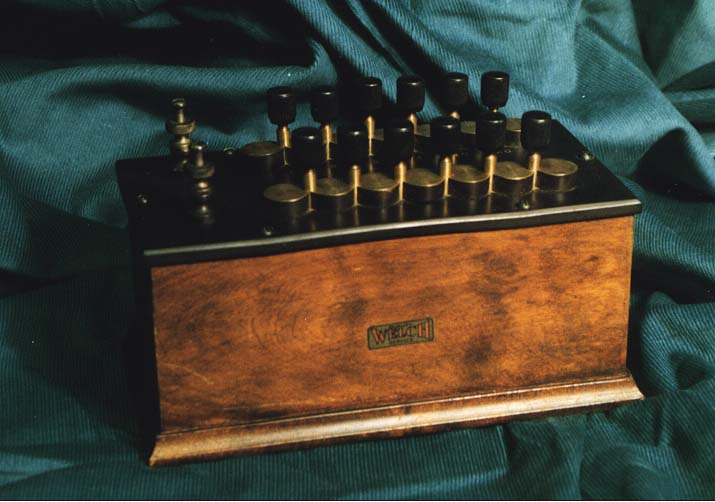
The instrument is contained in a 8x4x3 3/4h" birch? box stained at one time to look like mahogany. The top is of hard rubber with raised brass-work which has been nickel plated on top, and apparently stained black on the sides. The binding posts are nickel-plated brass with knurled nuts held on by the screw heads. Screws and brasswork are also nickel plated("white") tarnished to black. The resistance value is adjusted by inserting plugs (tapered brass with black hard rubber handles) into holes connecting the brass lugs on the top surface of the case. The total resistance of the box is 1,110 ohms divided as follows: 1, 2, 3, 4, 10, 20, 30, 40, 100, 200, 300, & 400. The resistance values are all white filled. There is an oval brass tag on the bottom corner of the box beneath the rear binding post stamped: HUMBOLDT S-T-C / 2112. There is a Welch decal in the center of the opposite panel of the box.
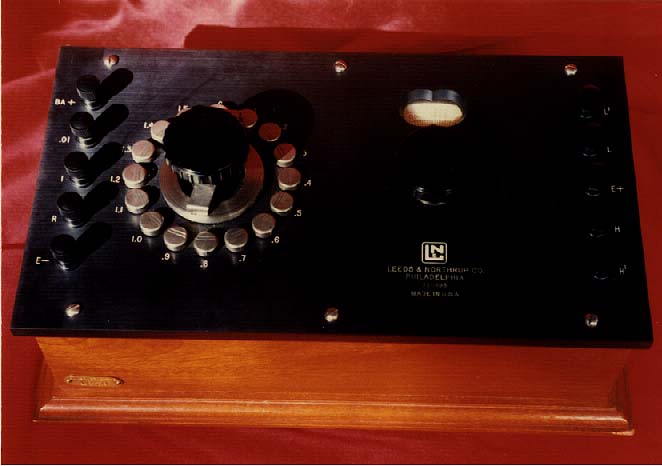
The selector switch moves a leaf spring along a heavy metal ring, alternately connecting to 16 metal disks to give ranges of 0–1.5 in 0.1 increments. Adjacent to it is the potentiometer dial with scales of 0–1000 (in red) and 0.000–0.100 Volt (in black). There are ten binding posts, five along the left side labeled: BA+, .01, 1, R, and E-; and five along the right side labeled: L', L, E+, H, and H'. The instrument has a 7 x 12 1/2" polished Bakelite top-plate, and a polished solid mahogany case and cover. It is 4 1/8" high to the top of the Bakelite plate. Condition: excellent, with some scratches noted on the cover, and small chip on right lower base of case. A serial number, 724495, is engraved on the Bakelite panel. A brass tag is nailed onto the mahogany base: Humboldt S-T-C 4879.
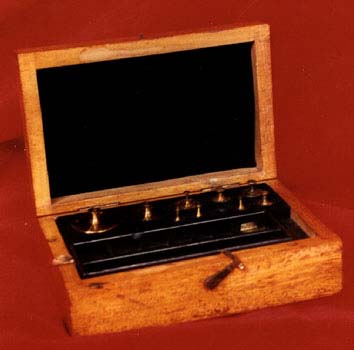
Gram weight set, 1–100g (1,1,?,2,5,10,10,20,50,100; one 10g and one 20g wt are replacements) in lacquered brass with some of original finish missing on weights, fractional weights and forceps are replacements. The weight set is held in a light mahogany ? case (138 x 92 x 49mm) with a molded Bakelite compartment for the fractional weights, the gram weights fitting into recesses in a velvet covered and lined wood block. There is a small brass hook and pin catch on the front of the case, the lid attached through two encased hinges. The remains of a BKH decal are visible on the top center of the lid, with Braun-Kneckt-Heiman-Co. / Germany stamped in the case body on the left outside. There is an oval brass tag, stamped HUMBOLDT S-T-C / 2085, attached with brass pins to the lower right of the right side of the case.
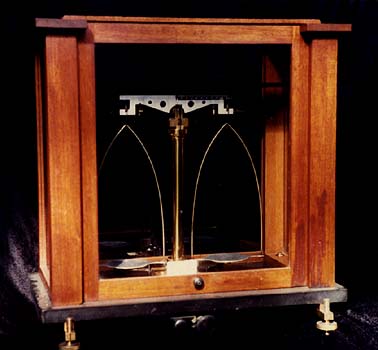
The balance has a 6 1/2" aluminum beam graduated in white figures against a black strip on the right side only in 10 mg by 0.2 mg with a 10 mg wire rider. The balance has knife edges on planes for the beam and both pans. The rider carrier is a simple hook on a brass rod sliding through a brass tube attached through the wood case on the right side of the balance. The beam is supported by a simple polished brass column on a square brass base plate bolted to the slate base of the balance. There is a white plastic scale attached to the front of the brass base plate graduated in red and labeled: voland & sons / (inc) / new rochelle, n.y. / patented. There is a single bullseye level behind the column. The release mechanism operates on the beam only (vertical lift type). The pans are arrested through a second knob mounted below the heavy (3/4") slate base, 16 5/8 x 9 1/2". The aluminum pans are supported by nickel plated brass bows and double hook hangers. The balance rests on a single rear post and two leveling screws operating on solid brass rod protruding from either side of the front of the slate base. The balance is enclosed in a glazed mahogany case, 15 1/2w x 14 1/2h x 9 1/2", with a single sliding door at the front. The case is stamped 21281 on the upper front right corner, and there is an oval brass tag on the top front right corner stamped: HUMBOLDT S-T-C / 2083.
The brass leveling feet have been stripped and refinished with shellac, the brass base plate cleaned and refinished with shellac, the remainder of the instrument and case merely cleaned and waxed or oiled as appropriate.
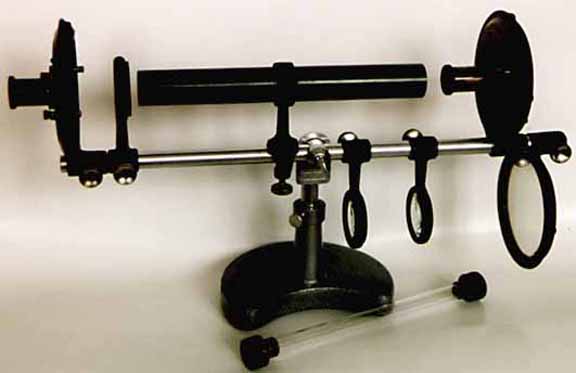
The instrument is incomplete, consisting of a series of loose components mounted on a new half inch aluminum rod and cast iron stand. There are two graduated (0–90–0–90–0 degrees by 5 degree increments), rotating, brass stages with 2 3/16" (55 mm) openings to accommodate windows, etc. held in place by stage clips. The stages are held in cast brass mounts. Currently each has a brass disk with a centered eyepiece mounted Nicol prism (one large and one small, held in cork); three 1 1/2" dia. lenses of varying focal length in cast brass mounts; one #47183 tube holder with 47180 20 cm solution tube, and one 3 1/4" mirror in a cast brass mount. The lenses and collars have 0.5" sleeves and thumb nuts to clamp onto a 0.5" rod. The tube holder uses a standard 'v' type clamp as seen in lab clamps to mount onto the rod. All cast pieces are finished in black crinkle enamel paint. Machined brass parts (eyepieces, stages) have a chemically darkened finish.
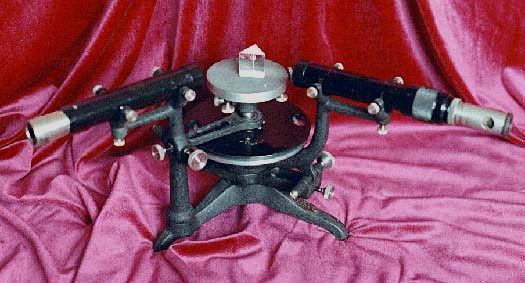
In this spectrometer the prism table, the collimator, and the telescope positions may be determined relative to a graduated circle. This example is AO Spencer's student instrument. It could be used for the determination and analysis of spectra using either a prism or grating. It could also be used in the measurement of angles between prism faces, the determination of angles of refraction and reflection, etc. In another common type of instrument, the Bunsen Spectroscope, there is no graduated circle, instead measurements are made relative to a projected scale.
Some contemporary/early descriptions of the spectroscope and its use are provided below:
"The Spectrometer" in Minor. Physical Measurements: ... Sound and Light (1917)
"The Spectroscope" in Noyes. A Textbook of Chemistry (1919)
"Spectroscopic Exam. of Blood" in Hawk. Practical Physiological Chemistry (1913)
Selections from: Baker. The Spectroscope...in General Analytical Chemistry (1923)
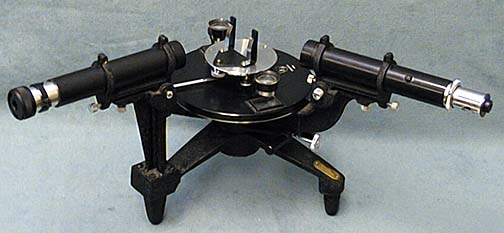
Gaertner small model spectroscope. The graduated aluminum circle is 125mm dia, with divisions every 30' and two verniers reading to 1'. A black japanned brass plate protects the graduated circle, having oval cutouts at 180° for reading the verniers. The instrument is stamped on the plate in white filled letters: WM. GAERTNER & CO / CHICAGO / 323. The circle with the attached telescope and the vernier plate move independently, and are both equipped with clamp and tangent screws. The aluminum prism plate is 80mm dia, and is fitted with leveling screws and a clamp for the prism (missing). The telescope and collimator are each held in a cast iron double cradle by five adjusting screws: two near the objective provide a pivot, while the remaining three provide horizontal and vertical angular adjustment. The entire instrument sits on a substantial cast iron tripod. All adjusting screws are of polished nickel plated brass with checkered knurling. The telescope and collimator each have 25mm objectives and 160mm? focal length. The slit has nickel silver jaws, adjusted by a screw to the side (replacement). The telescope focuses by means of a knurled ring. The eyepiece is equipped with a beam splitter accessed through a hole to the right side for superimposing scales, etc. on the spectral image. An oval brass tag, attached with brass pins to the opposite right of the collimator, is stamped: HUMBOLDT S-T-C / 2103.
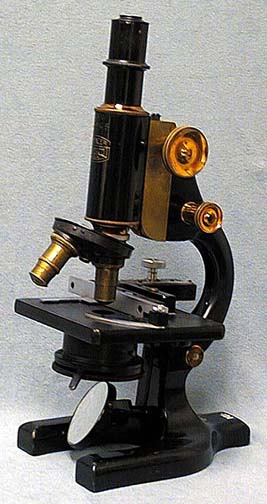
The microscope stands 11 1/4" tall when closed. It is finished in black with exposed metal in lacquered brass. The knobs have dished surfaces with round knurled double ridges on the edges. There is no draw-tube in this low-cost, simplified microscope. The fine focus is graduated every 2.5 microns. There is a 10X ocular with conical mounting for the eye lens. There are two objectives on a revolving nosepiece (two engraved ::SPENCER LENS CO, BUFFALO, N.Y.:[/ :NUM. APER. 0.65:44X::4MM/283211]; 277531/16MM.N.A.0.25 10X]. The stage is 110x105mm square Bakelite. The substage is of the Spencer fork-type, with built-in iris diaphragm, which swings out for easy condenser cleaning and replacement. There is a 48mm plano-concave mirror on a swinging arm. The surface condition of the microscope is excellent. A serial number, 89599, is stamped on the frame above the focusing knobs. It has a HSTC number of 2063.
The mechanical stage is a later addition, probably installed after 1950.
The instrument in housed in a 71/8 x 6 3/4 x 3 1/4" walnut case with a leather handle. All hardware is nickel-plated brass. The front panel has a window cut into it to view the meter face. The meter has a mirrored scale. The serial number (52947) is hand written on the white paper scale behind the face plate. Only one of the two screws in the side of the case allowing access to the movement is sealed with black sealing wax(?) and stamped with a "W," the other seal has fallen off. The instrument has four rubber feet on the bottom for storage and four more feet on the back for use during operation. There are two nickel-plated brass binding posts on the left side of the instrument's case.