-
Title
-
Abbe Refractometer
-
History / Usage
-
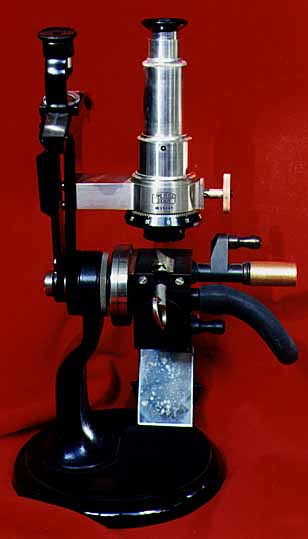
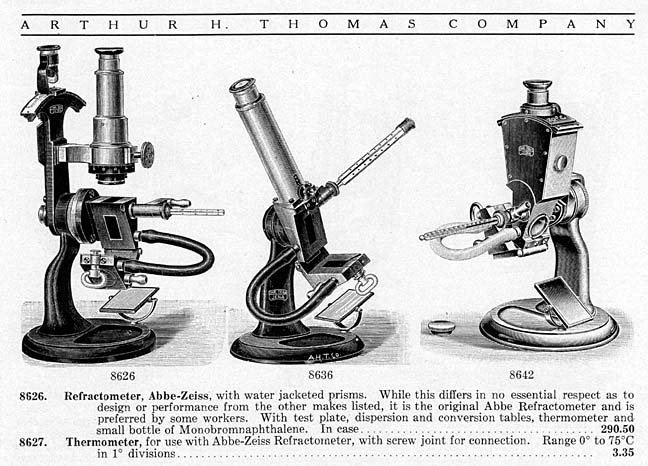
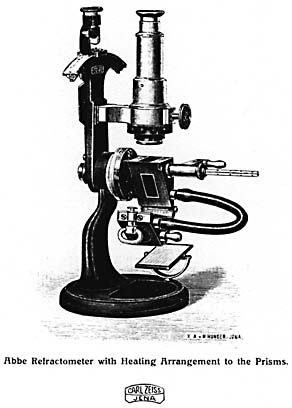
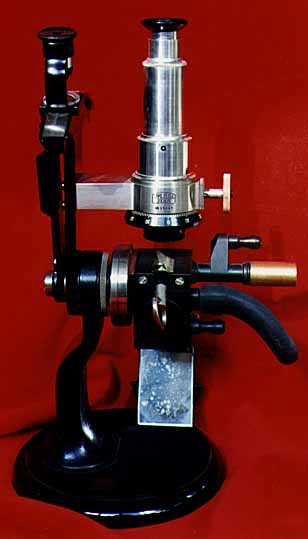
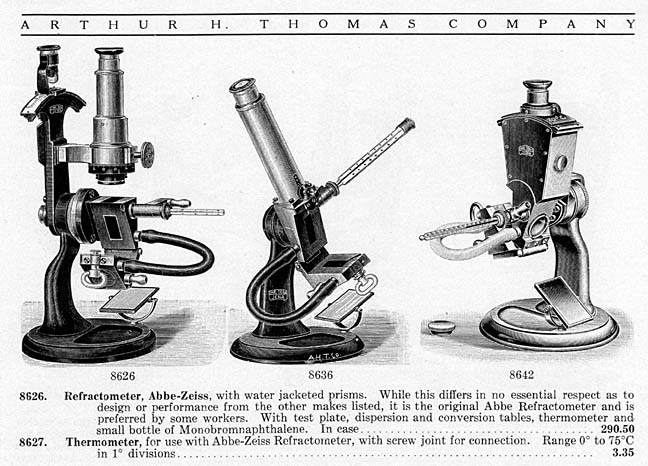
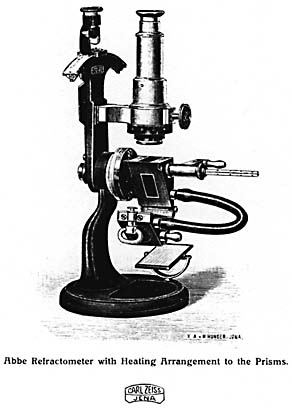
The redesigned stand of this instrument makes it stand out relative to the earlier Zeiss instruments. The new stand, introduced around 1913, is round with a curved limb, and made from japanned cast iron rather than the nickel plated brass of previous models. Other new features make the instrument more convenient for the user, including the reoriented scale and magnifier so that the telescope, scale, and magnifier all now face the user. The dispersion scale has also been angled so that it can be viewed with a slight movement of the eye from the telescope eyepiece. A handle has been added to the alidade, easing its adjustment. The catalog scan is taken from the Arthur H. Thomas Co. catalog, Laboratory Apparatus and Reagents. Philadelphia (1921).
The design of this instrument remained the basis of Carl Zeiss refractometers until 1950 with the exception of changes in the mirror mount and the alidade fine adjustment, as seen in the 1926 example in this exhibit.
The Abbe refractometer provides a quick and easy means for determining refractive index and dispersion of liquids and solids. Its most common use is the determination of the concentrations of solutions. It is used in the examination of organic compounds (oils, solvents, etc.), solutions, food products, and serum protein concentration. The refractive index is measured by aligning the crosshairs in the telescope with the line of total reflection. This line is moved by rotating the prism assembly with the alidade. Reading at constant temperature is important, thus the prisms are enclosed in a water jacket which may be connected to a constant temperature bath.
Ernst Abbe published his Neue Apparate.... (1874)4 in which he discussed the theory and described instruments for the measurement of refractive index using prisms and by total reflection. It is here that he first describes the Abbé refractometer for determining the refractive index of fluids. This initial instrument includes Amici prisms and is essentially the same as a modern Abbé refractometer, though without temperature jacketing. An instrument very similar to that described by Abbe in 1874 was shown in catalogs beginning in 18935, shortly after the formation of the Instrument Department of the Carl Zeiss works in 1890.6 This style, with slight modifications7, continued to be seen in catalogs at least until 1910. A new design, apparently identical to the specimen in this collection, appears in a catalog of Zeiss instruments exhibited in Dresden in 1911.3 This instrument appears in catalogs at least as late as 1927.8 By 1934 this design had been modified by placing the mirror on a swinging arm attached to the prism axis and by adding a rack and pinion adjustment to the alidade.
Early descriptions of the features and use of the Abbe refractometer are provided below:
-
Abbe's Refractometers complete text Carl Zeiss Co. Jena (1907)
Refractometers from Encyclopedia Britannica, 11th ed. (1911)
A brief essay, The Chemical Refractometer, describes the characteristics, design, and use of these instruments. A detailed history, The Evolution of the Abbe Refractometer, traces the development of this valuable instrument to around 1980.
-
Description
-
The instrument stands 11 1/2" high in the closed, vertical position. The round, cast iron base is 5 1/2" diameter. The curved edge of the base is black japanned, while the top is finished in a fine black crinkle enamel. The post is heavy cast iron, finished in crinkle enamel, and bolted to the base from below with three heavy screws. There is a small (1/2" x 11/16") plaque attached to the base with four screws with the Carl Zeiss Jena "lens" logo with Germany written beneath. The logo is also engraved and black-filled on the telescope arm, along with the serial number: Nr.15645. The inlaid nickel silver scale has black-filled graduations to the thousands place, with numbering to the hundreds-place. The tenths-place is also numbered, with larger numerals (1,X) at the even-numbers, and is carried on a black japanned iron (or steel) arm. The alidade is black crinkle finished brass. The telescope, telescope arm and other furniture are nickel plated, while the prism holder/heating block has a flat black oxidized coating. There is a small, square, watch-key type shaft for adjusting the Amici prisms in the side of the telescope. The original thermometer holder has been replaced with a custom brass adaptor to fit rubber stoppers. The instrument is engraved on the telescope arm: HSC 5374.
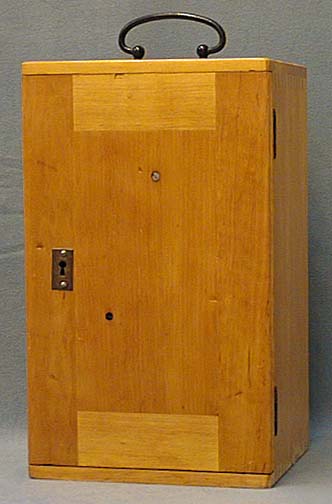
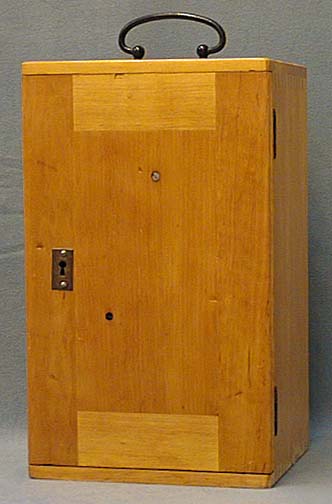
The instrument is in its original light hardwood ("alderwood") case (8 1/4 x 6 3/4 x 14" h), with a black painted iron carry-handle and nickel plated keyhole cover.
-
producer
-
Carl Zeiss/Jena
-
Date Created
-
c. 1938
-
Is Part Of
-
Humboldt State College
-
Subject
-
Refractometers; refractive index; optical instruments; chemical analysis
-
Identifier
-
HSC 5374
-
References
-
Abbe's Refractometers complete text Carl Zeiss Co. Jena (1907)
Refractometers from Encyclopedia Britannica, 11th ed. (1911)