-
Title
-
Abbé Refractometer
-
History / Usage
-
The Abbé refractometer provides a quick and easy means for determining refractive index and dispersion of liquids and solids. It is used in the examination of organic compounds (oils, solvents, etc.), solutions, food products, and serum protein concentration. The instrument is operated by aligning the cross hairs in the telescope with the line of total reflection. This line is adjusted by rotating the prism assembly with the alidade. The refractive index is then read off directly from the graduated arc to four significant figures. Reading at constant temperature is important, thus the prisms are enclosed in a water jacket which may be connected to a constant temperature bath.
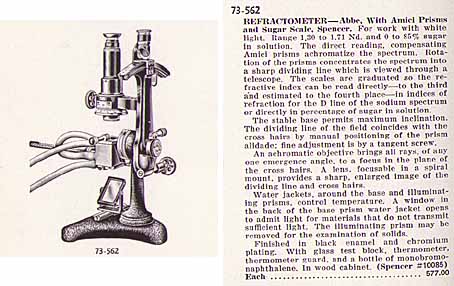
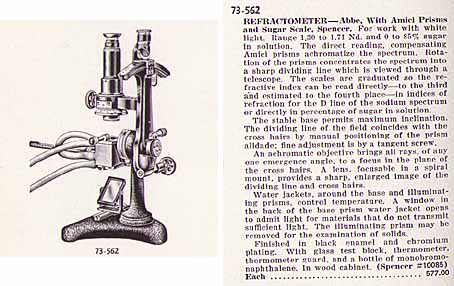
Ernst Abbé published his Neue Apparate.... (1874) in which he discussed the theory and described instruments for the measurement of refractive index using prisms and by total reflection.1 It is here that he first describes the Abbé refractometer for determining the refractive index of fluids. This initial instrument includes Amici prisms and is essentially the same as a modern Abbé refractometer, though without temperature jacketing. The Spencer Lens Company began selling an Abbe refractometer in about 1922. It differed from the current instrument in having a tripod base and a gear-drive alidade. The base was redesigned by 1924. The current instrument was in use at Humboldt from 1953 until it was replaced in 1982.
Early descriptions of the features and use of the Abbé refractometer are provided below:
-
Abbe's Refractometers complete text Carl Zeiss Co. Jena (1907)
Refractometers from Encyclopedia Britannica, 11th ed. (1911)
-
Description
-
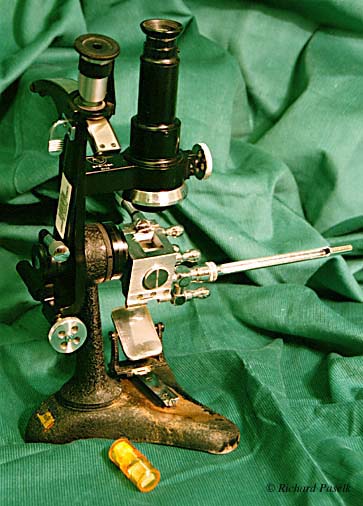
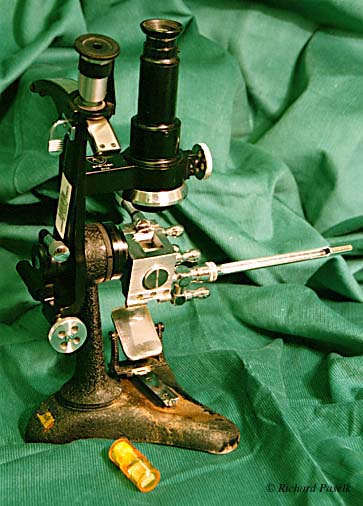
The instrument stands 11.5" high in the closed, vertical position. The base is of cast iron with black crinkle finish, some of which has come off to expose the iron below the mirror rail. The scale and readout arms are of steel. All of the control knobs and the alidade handle are in heavy chrome plating. The solid metal two sided mirror is mounted on an adjustable dovetail slide. The scale is engraved on an inlaid German silver strip with scale divisions to the thousands place (nD 1,300–1,710), and numbered to the hundreds place. The number: 788432618 is engraved on the scale just past 1710. The readout is viewed with an adjustable triplet magnifier. A hairline engraved on a glass window affixed via a threaded retaining ring to the prism alidade determines the index. The prism alidade has a tangent screw fine adjustment. The refractometer telescope is heavy black enameled brass, with the AO shield logo engraved and white filled on the arm over Spencer and the serial number: 2009. The Amici color compensating prism scale is finished in brushed chrome with black filled engraved divisions (0–60–0) and adjusted with a knurled wheel. The prism holder is finished in brushed chrome with polished chrome tubulatures for connecting to a circulating bath for temperature control. There is a chromed brass thermometer shield and mercury-filled thermometer. Engraved: HSU 43923.
The instrument has its original black leatherette covered hardwood case and its original glass block refractive index standard in a small plastic vial (shown in the photo).
-
producer
-
AO-Spencer
-
Date Created
-
1953
-
Is Part Of
-
Humboldt State College
-
Subject
-
Refractometers; refractive index; optical instruments; chemical analysis
-
Identifier
-
HSU 43923
-
References
-
1 Abbé, E. Neue Apparate zur Bestimmung des Brechungs - und Zerstreuungsvermögens fester und flüssiger Körper. Mauke's Verlag, Jena (1874) Taffel: Fig. 5-7.