-
Title
-
Wide Field Binocular Microscope
-
History / Usage
-
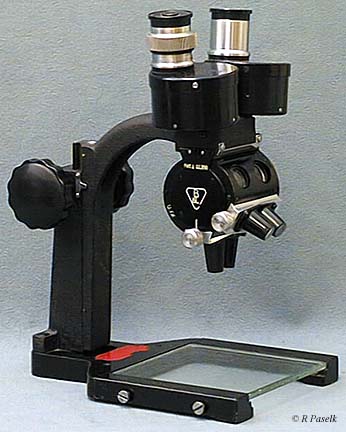
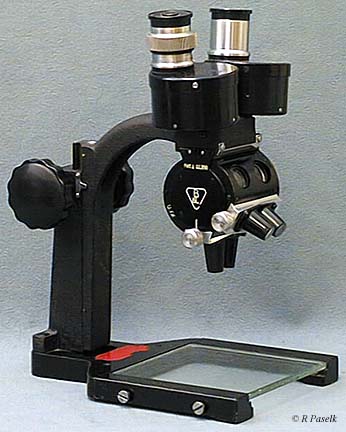
This is a general purpose, low magnification (3–150 x) microscope used for three-dimensional viewing in biology (sometimes referred to as a dissecting scope), assembly and inspection in industry, etc. This type of low power, binocular microscope was first designed by Greenough in 1897, and was first manufactured by Zeiss.1 It consists of two independent microscopes with erecting prism systems focused on the same object from slightly different angles to give an exaggerated stereoscopic view. Because of the inclinations of the optical axis of the two microscopes from the vertical, only the center of the field is in focus for both, however, the composite image appears sharp over the entire field due to the opposite nature of the focusing errors, the accommodation of the eye, and the great depth of view of the low power objectives.
-
Description
-
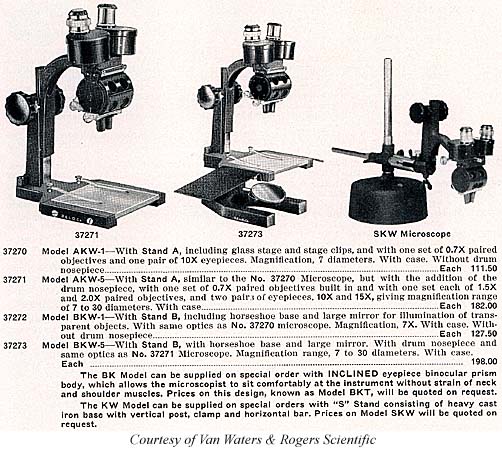
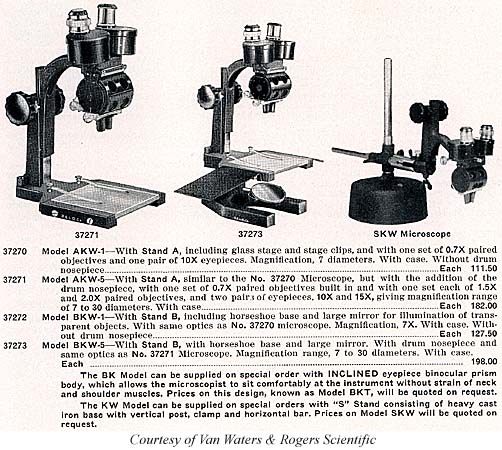
The microscope stands 9" high when closed, the base is 5 1/4" wide by 7 1/8" deep. It is scribed HSC 43765 on the right-hand stage-bracket and the right-hand prism cell next to the B&L logo and serial number (TP 484). The stand is finished in black crinkle-paint, while the base and optical head is black japanned. The 0.7x objectives are built in to the drum nose-piece. Two additional sets of objectives, 1.5x and 2.0x, are on dove-tail sliders. Both eyepieces are replacements as is the glass stage.
-
producer
-
Bausch & Lomb
-
Date Created
-
1946
-
Is Part Of
-
Humboldt State College
-
Subject
-
Binocular microscopes; stereoscopic viewing; biological microscopy
-
Identifier
-
HSC 43765
-
References
-
1 Needham, George Herbert. The Practical Use of the Microscope. Charles C. Thomas Publisher, Springfield (1958) p. 64.
-
2 Bracegirdle, Brian. Notes on Modern Microscope Manufacturers. Quekett Microscopical Club, Oxford (1996) p. 11.