-
Title
-
Duboscq Colorimeter
-
History / Usage
-
The Duboscq colorimeter was invented by Jules Duboscq in 1870. The Duboscq colorimeter was the most widely manufactured and used of the various colorimeter designs.1 It is also an instrument design of remarkable longevity, with very similar instruments still being sold. A modern version, for example, is shown in the 1996 edition of a standard analytical chemistry text.2
Colorimeters are used to determine the concentrations of substances by measuring color intensities. The Duboscq type of colorimeter works by comparing the colors of two solutions of a colored substance, a standard with a known concentration, and a sample with an unknown concentration. A clear crystal prism dips into each solution and may be adjusted so that the path lengths of the light through the two solutions can be adjusted. The instrument then takes the light from the two prisms and arranges it to form two halves of an illuminated field in the viewing telescope. In use the operator adjusts the prisms to give equal intensities in both fields, at which point the concentration of the unknown sample can be calculated by the following relation:3
(concentration 1)(pathlength 1) = (concentration 2)(pathlength 2)
This instrument was used in the Biology Department's physiology laboratory at Humboldt. The Chemistry Department also had a Duboscq Colorimeter by B&L, but it was surplused in the 1960's. The manual is held by the museum, and is linked below.
-
Contemporary/early descriptions of the colorimeter and its use are provided below:
Duboscq Colorimeter - Directions for Use: Bausch & Lomb Optical Company (1946). Manual from HSU Chemistry Department files.
Types of Colorimeters and Their Use Myers (1919)
Colorimetric Analysis. Preface - Chapter III From: Snell (1921).
-
Description
-
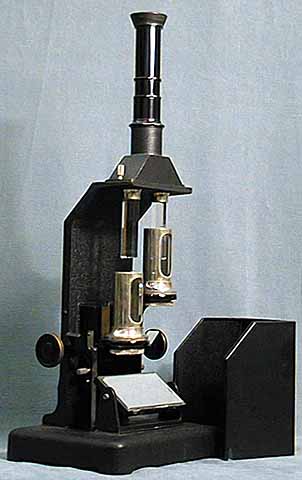
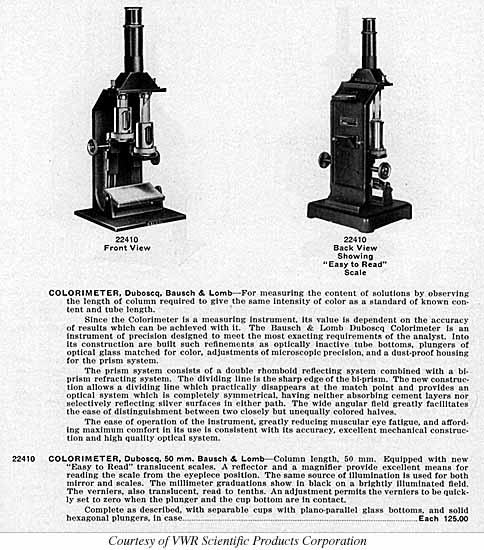
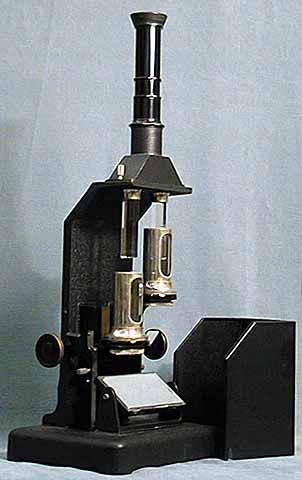
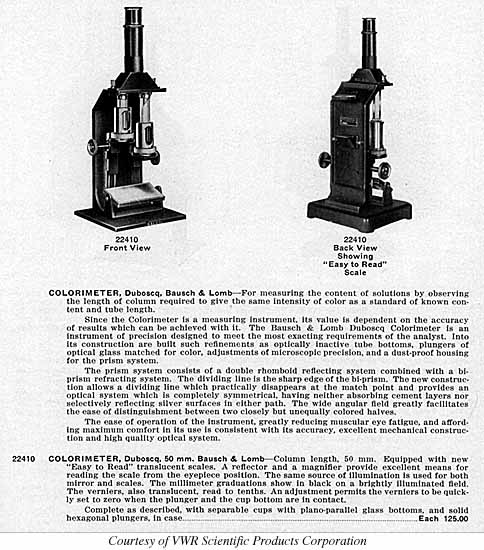
The instrument stands 16" high (drawtube closed) on a hollow 5 x 6" cast iron base. The stand is also cast iron, with a fold-up cast iron handle on the back. The prism housing/telescope mount is cast brass, attached with nickel-plated brass knurled screws. The sample cups (55 mm deep) are glass in nickel-plated brass shields (total height 72 mm). Each cup is held in a bracket on a focusing rail with a 60 x 1 mm scale read against a 0–10 vernier scale. Small mirrors mounted at 45° allow viewing the scales from the telescope eye-position. The hexagonal glass prisms are 55 mm long with an optical finish on all surfaces. The optical shield is formed of steel sheet. The mirror illuminator may be flipped over to give a flat white surface instead. A black enameled aluminum tag on the back of the stand reads, in raised metal letters:
BAUSCH & LOMB OPTICAL CO
ROCHESTER NY USA
NO 2451
with the serial number stamped on a blank metal field.
-
producer
-
Bausch & Lomb Optical Co.
-
Date Created
-
<1941
-
Subject
-
Colorimeters; colorimetric analysis; chemical analysis; optical instruments
-
Identifier
-
NO 2451
-
References
-
1 Stock, John T. The Duboscq Colorimeter and Its Inventor. Journal of Chemical Education 71. (Nov. 1994) 967–70; Turner, Gerard L'e. Nineteenth Century Scientific Instruments. Sotheby/University of California Press (1983) p. 223
-
2 Skoog, Douglas A., West, Donald M., and Holler, F. James. Fundamentals of Analytical Chemistry 7th ed. Saunders College Publishing, Fort Worth (1996).
-
3 The relationship between pathlength and light intensity reduction, upon which this relationship is based, was first described by Pierre Bouguer, a French mathematician and astronomer, in 1729. This work was extended and put into a more mathematically rigorous form by Lambert, a German physicist and mathematician, which he published in his book Photometrica in 1760 (hence, "Lambert's Law"). Both worked with glass plates or filters, however, and a method relating color intensity to pathlength for determination of concentrations in solution was not described until 1853 by Müller. (from Szabadváry, Ferenc. History of Analytical Chemistry. Pergamon Press, Oxford 1966 [English translation, orig. Hungarian: 1960])
-
4 Bracegirdle, Brian. Notes on Modern Microscope Manufacturers. Quekett Microscopical Club, Oxford (1996) p. 11.